




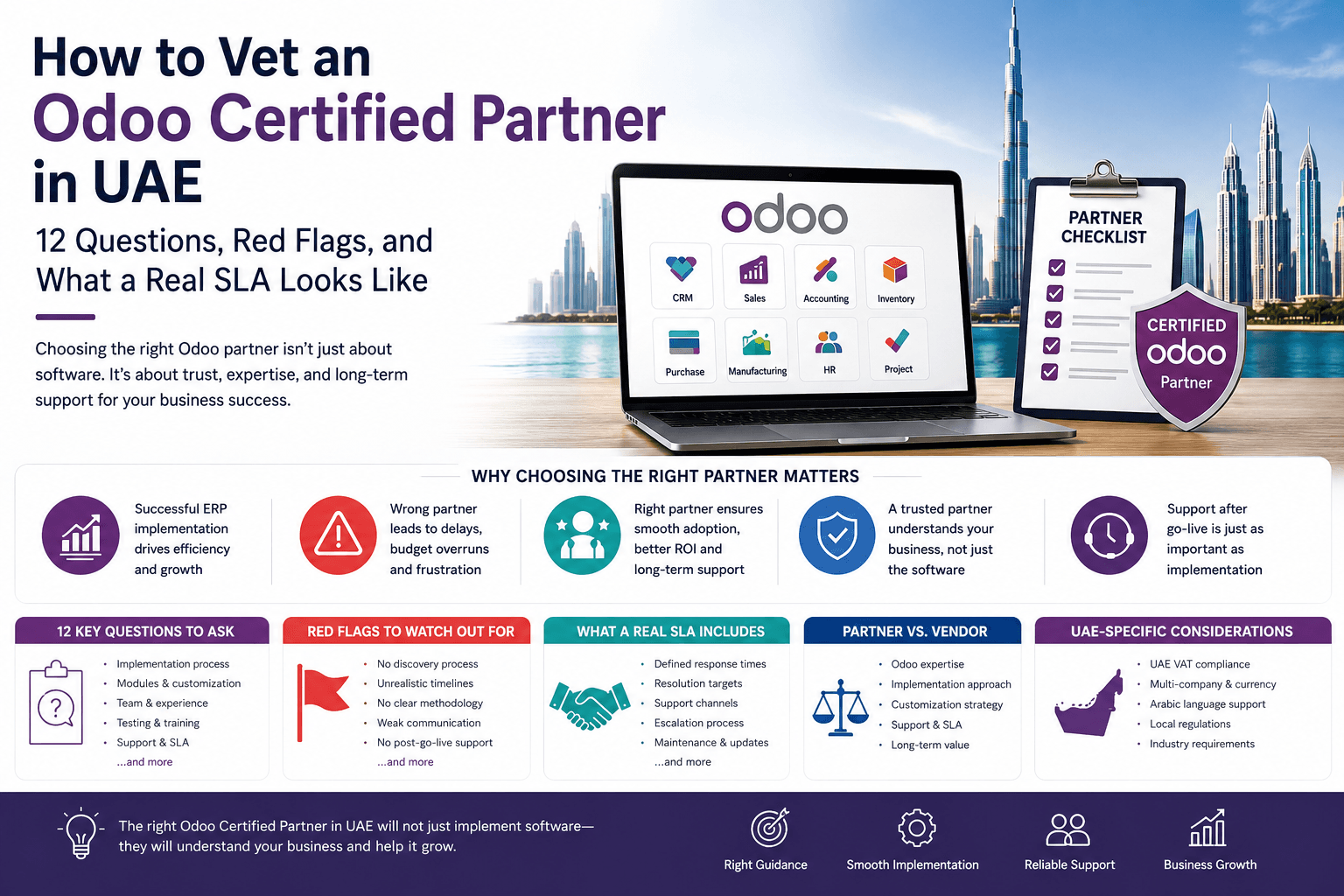
Imagine you’ve spent weeks comparing ERP platforms, attended product demos, and finally decided that Odoo ERP is the right fit for your business. The next step seems straightforward: hire an implementation partner and begin the project.
This is where many UAE businesses make their biggest mistake.
The success of an ERP implementation rarely depends on the software alone. More often, it’s determined by the team responsible for configuring the system, understanding your workflows, training your employees, and supporting you long after the system goes live.
A poor implementation can lead to months of delays, unexpected customization costs, frustrated users, and operational disruptions. In contrast, the right Odoo Certified Partner helps you simplify processes, reduce manual work, and create a system that grows with your business.
With more companies offering Odoo implementation services in the UAE, choosing the right implementation partner has become just as important as choosing the software itself. Before signing any proposal, it’s worth slowing down and asking the right questions.
This guide, put together by the team at Inova Tech, will help you evaluate an Odoo Partner in the UAE, identify common warning signs, and understand what professional implementation and support should actually look like.
1. Have You Worked With Businesses Like Ours?
Every industry has its own operational challenges.
A distributor needs accurate inventory forecasting. A manufacturer cares about production planning. A retailer focuses on point-of-sale integration, while a professional services company prioritizes project management and resource planning.
An implementation partner who understands these differences can recommend better workflows from the beginning.
Rather than asking whether they’ve implemented Odoo before, ask whether they’ve solved problems similar to yours.
Listen carefully to how they answer.
Do they describe business challenges, implementation decisions, and measurable outcomes? Or do they simply list company names without explaining the work they performed?
A partner who understands your industry is far more likely to anticipate challenges before they become expensive problems.
Ask this follow-up question:
“If you were implementing Odoo for a company like ours today, what would be the biggest challenge?”
The quality of that answer often tells you more than any sales presentation.
2. How Will You Understand Our Business Before Making Recommendations?
If a partner can provide an accurate quotation after a single sales call, that’s usually a red flag.
ERP implementation isn’t like buying office furniture. Every business has unique approval processes, reporting requirements, operational bottlenecks, and compliance needs.
Professional ERP consultants begin with discovery not configuration.
A proper discovery phase usually includes stakeholder interviews, workflow discussions, process mapping, and identifying gaps between your current operations and standard Odoo functionality.
This phase might feel time-consuming, but it often saves weeks of rework later.
Partners who skip discovery frequently compensate by adding costly change requests once implementation has already started.
A better question to ask is:
“What documents will we receive after the discovery workshop?”
A professional partner should be able to provide requirement documentation, implementation scope, project milestones, and a clear roadmap before development begins.
3. What Does Your Implementation Process Look Like?
Experienced ERP consultants rarely talk about software first.
Instead, they talk about process.
Most successful Odoo implementations follow a structured roadmap:
- Discovery and business analysis
- Solution design
- System configuration
- Necessary customization
- Data migration
- User Acceptance Testing (UAT)
- Employee training
- Go-live support
- Continuous improvement
If a partner struggles to explain how they manage projects from start to finish, that’s worth investigating.
ERP implementations involve many moving parts. Without a clear methodology, delays and misunderstandings become much more likely.
Ask them to walk you through a recent project timeline.
If the explanation feels organized and transparent, it’s a good sign they’ve done this many times before.

4. Are You Recommending Odoo or Selling Every Module Available?
One of the easiest ways to increase implementation costs is by deploying more modules than your business actually needs.
A thoughtful consultant doesn’t start with a list of features.
They start with business priorities.
For example, a growing trading company may benefit from implementing Sales, Inventory, Purchase, and Accounting first, leaving CRM automation or advanced manufacturing modules for a later phase.
Rolling out ERP in stages often improves user adoption and reduces implementation risk.
Be cautious if someone recommends every available module during the first meeting.
Good ERP consulting is about solving business problems not maximizing software scope.
5. How Much Customization Is Really Necessary?
Every business likes to believe its processes are unique.
Sometimes that’s true.
More often, they’ve simply become accustomed to doing things a certain way.
One of the most valuable traits of an experienced Odoo consultant is knowing when not to customize.
Before writing a single line of code, they should ask:
“Can standard Odoo handle this requirement with configuration?”
Excessive customization increases implementation costs, makes future upgrades more complex, and creates additional maintenance work over the life of the system.
That doesn’t mean customization is always bad.
If a custom workflow provides genuine operational value or supports a competitive advantage, it’s often worth the investment.
The key is making that decision intentionally not automatically.
6. Who Will Actually Be Delivering the Project?
It’s surprisingly common for businesses to meet senior consultants during the sales process, only to discover that junior resources are handling the implementation after the contract is signed.
Don’t hesitate to ask who will be involved in your project.
A typical ERP implementation team may include:
- Project Manager
- Functional Consultant
- Technical Consultant
- QA or Testing Specialist
- Support Engineer
Understanding who is responsible for each stage of the project helps set expectations and improves accountability.
A dedicated project manager also gives your team a single point of contact throughout the implementation, making communication far more efficient.
One simple question can reveal a lot:
“Will we be working with the same consultants from discovery through go-live?”
If the answer is unclear, it’s worth digging deeper.
7. How Will You Handle Data Migration?
Ask any ERP consultant about the most underestimated part of an implementation, and data migration will almost always make the list.
Migrating years of customer records, inventory data, supplier information, accounting transactions, or product catalogs isn’t simply a matter of importing spreadsheets. Inaccurate or duplicate data can quickly undermine confidence in the new system.
A capable implementation partner won’t rush this stage. Instead, they’ll explain how they’ll clean, validate, and test your data before anything reaches your live environment.
It’s also worth asking whether they’ll perform trial migrations. Testing the process before go-live helps uncover missing fields, formatting issues, or inconsistencies while there’s still time to fix them.
A reassuring response sounds something like this:
“We’ll run multiple test migrations, validate the results with your team, and only proceed once everyone is confident in the data.”
That’s the level of planning you should expect.

8. What Does Your Testing Process Look Like?
Many ERP problems don’t appear because the software is faulty, they appear because nobody tested how the software would work in real business scenarios.
Before going live, your team should have the opportunity to perform User Acceptance Testing (UAT). This is where employees test everyday tasks such as creating sales orders, approving purchase requests, generating invoices, or processing inventory movements.
This phase often reveals small issues that could otherwise become major disruptions after launch.
If a partner tells you that users can “test the system once it’s live,” consider that a warning sign.
A well-managed implementation should include structured testing, documented feedback, and enough time to resolve issues before employees begin relying on the system every day.
9. How Will You Prepare Our Team to Use Odoo?
Technology projects don’t fail because people dislike new software. They fail because people don’t understand how to use it confidently.
Training should never be treated as a single presentation on the day of deployment.
Different departments use ERP differently. Finance teams have different responsibilities than warehouse staff, sales representatives, HR professionals, or senior management.
A thoughtful implementation partner tailors training to each group, provides practical exercises, and leaves behind documentation or recorded sessions that employees can revisit later.
Good training doesn’t just explain where to click, it helps employees understand why processes are changing and how the new system will make their work easier.
When users feel involved rather than instructed, adoption tends to happen much more naturally.
10. What Happens After We Go Live?
Go-live isn’t the finish line, it’s the beginning of a new way of working.
The first few weeks are when employees ask questions, discover edge cases, and adapt to new workflows. That’s why post-launch support is just as important as implementation itself.
Before signing a contract, ask exactly what happens after deployment.
Will there be dedicated support during the first month? Who handles urgent issues? How are bugs reported? What happens when a new version of Odoo is released?
A reliable implementation partner should have clear answers not vague promises.
Support isn’t just about fixing problems. It’s about helping your business continue improving long after the project is complete.
11. Can You Share Real Project Experience?
Most providers will tell you they have experience. The more useful question is whether they can explain that experience.
Instead of asking for a list of clients, ask them to walk you through a recent implementation.
What challenges did the customer face?
How was the solution designed?
What compromises were made?
What lessons were learned?
The best consultants are usually happy to discuss projects in detail while respecting client confidentiality. Those conversations often reveal far more about their expertise than marketing brochures ever could.
12. Can We Review Your Support Agreement Before Signing?
Support is often discussed right at the end of the sales process, but it’s one of the most important parts of your relationship with an ERP partner.
A professional Service Level Agreement (SLA) should explain:
- How quickly support requests are acknowledged
- Expected resolution times
- Escalation procedures
- Support channels
- Business hours
- Planned maintenance
- Software updates
- Responsibilities of both parties
If the SLA is vague or doesn’t exist, you’ll have very different expectations once the system is live.
The best time to discuss support is before the contract is signed not after something goes wrong.

Warning Signs You Shouldn’t Ignore
During the evaluation process, pay attention to how a partner worksnot just what they promise.
Some of the most common warning signs include:
- Providing a fixed quote without understanding your business.
- Skipping discovery workshops altogether.
- Recommending extensive customization before reviewing your processes.
- No dedicated project manager.
- No documented implementation methodology.
- Little or no discussion about testing.
- No structured training plan.
- Limited post-go-live support.
- No written Service Level Agreement.
- Difficulty providing relevant project references.
One or two of these may not be deal-breakers on their own. However, if several appear together, it’s worth exploring other options.
A Practical Approach to Odoo Implementation
At Inova Tech, we believe successful ERP projects begin with understanding the business, not the software. Rather than jumping straight into configuration, our Odoo implementation approach starts with listening. We work closely with stakeholders to understand existing processes, identify operational challenges, and define clear project objectives before implementation begins.
From there, the focus shifts to building a practical roadmap. Standard Odoo functionality is used wherever possible, with customization introduced only when it delivers measurable business value. Every phase, from data migration and testing to user training and post-go-live support, is designed to reduce risk and encourage long-term adoption.
ERP implementation isn’t a one-time event. As businesses grow, their processes evolve too. That’s why continuous optimization remains an important part of the journey, helping organizations get more value from their Odoo investment over time.
Wrapping It Up
Choosing an Odoo Certified Partner isn’t just about comparing proposals or finding the lowest price. It’s about finding a team that understands your business, communicates openly, and has a proven process for delivering successful ERP projects.
Before making your decision, take the time to ask thoughtful questions, review the implementation methodology, understand the support model, and speak with previous clients if possible.
A little extra due diligence at the beginning can save months of frustration later.
If you’re planning an Odoo ERP implementation in the UAE and want an experienced team to help you evaluate your requirements, develop a realistic roadmap, or assess your current processes, Inova Tech is always happy to start with a conversation not a sales pitch.