


Running a small business in the UAE means wearing multiple hats. You’re managing sales, keeping track of inventory, handling invoices, and making sure your finances stay in order, all while trying to grow your business. At some point, someone has probably told you, “You should just get Odoo.”
Sounds simple enough until you visit the pricing page and find multiple plans, dozens of modules, and a long list of features. Suddenly, choosing the right option doesn’t feel so straightforward.
You’re not alone. We speak with small business owners across Dubai, Abu Dhabi, Sharjah, and the rest of the UAE every week who are facing the same challenge. They know their current systems: spreadsheets, disconnected apps, and manual processes are slowing them down, but they’re unsure where to begin with Odoo for small business needs.
In this guide, we’ll help you understand which Odoo plan makes the most sense for a small business, which modules are worth investing in first, and what kind of return on investment (ROI) you can realistically expect after implementation.
What Does Odoo Actually Do?
Let’s keep it simple.
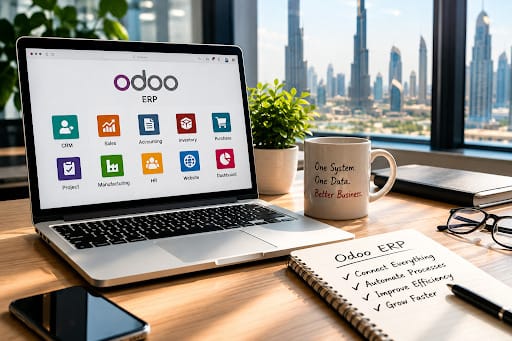
Odoo is an all-in-one business management platform that helps you manage different areas of your business from a single system. Instead of switching between separate applications for sales, accounting, inventory, HR, and customer management, everything works together in one place.
Think about your current workflow.
Your sales team might use one application to manage leads, your accountant works in different accounting software, and your warehouse staff tracks inventory manually. Because these systems aren’t connected, information has to be entered multiple times, increasing the chances of mistakes and slowing everyone down.
Odoo brings all of these processes together so your teams work from the same data.
For businesses operating in the UAE, this is especially valuable. Whether you’re managing VAT compliance, trading in multiple currencies, or preparing for business growth, Odoo provides a centralized platform that scales alongside your business instead of creating additional complexity.
Why Small Businesses in the UAE Are Choosing Odoo
Many traditional ERP systems were built with large enterprises in mind. They often require significant budgets, lengthy erp implementation projects, and dedicated IT teams to manage them.
For smaller businesses, that’s simply not practical.
Growing businesses need software that is affordable, flexible, and easy to manage without hiring a full-time technical team. That’s one of the biggest reasons Odoo has become a popular choice among trading companies, retailers, distributors, service providers, and SMEs throughout the UAE.
Some of the key advantages include:
- Pay only for the applications your business actually needs.
- Built-in support for UAE VAT requirements.
- Add more modules as your business grows without changing platforms.
- A user-friendly interface that helps employees get comfortable with the system quickly.
Instead of replacing your software every few years as your business expands, Odoo allows you to continue building on the same platform.
Which Odoo Plan Should You Choose?
Choosing the right plan is often where business owners hesitate. Selecting a plan that’s too basic may limit future growth, while paying for advanced features you don’t need can increase unnecessary costs.
| Plan | Best For | What You Get | Rough Monthly Cost |
| One App Free | Solo founders, very small teams | One app, unlimited users | Free |
| Standard | Small businesses ready to grow | Full apps, cloud hosting | Budget-friendly, per user |
| Custom | Businesses with specific needs | Full custom setup, on-site or cloud | Higher, based on needs |
If you’re just getting started and only need one function such as CRM or invoicing the free plan can be a practical way to explore the platform.
However, once your business begins managing inventory, accounting, sales, and multiple users, the Standard Plan is usually the best fit for most small businesses in the UAE. It provides access to the complete application suite while keeping costs manageable.
Businesses with highly customized workflows or industry-specific requirements generally benefit from the Custom Plan, which offers greater flexibility and customization options.
Can You Start Using Odoo for Free?
Yes.
One of Odoo’s biggest advantages is that you can begin with a free plan if your requirements are relatively simple. For example, if you only need basic customer relationship management or invoicing, you can start without making an upfront software investment.
This allows business owners to evaluate how the platform fits into their daily operations before committing to additional applications.
As your business expands, adding new modules is straightforward, allowing you to build your system gradually rather than implementing everything at once.
That said, most growing businesses eventually upgrade. Once you require automation, integrated reporting, inventory management, or multiple connected applications, a paid plan offers significantly more value and efficiency.
Which Modules Matter Most for a Small Business?
One of the most common mistakes we see is businesses trying to implement every available application from day one.
That usually creates unnecessary complexity.
Instead, we recommend starting with the modules that solve your biggest operational challenges today. Once your team becomes comfortable with the platform, expanding is much easier.
For most small businesses in the UAE, these are the modules that deliver the quickest value:
- Accounting – Simplifies invoicing, VAT compliance, bank reconciliation, and financial reporting.
- Sales – Helps manage quotations, sales orders, and customer follow-ups from one dashboard.
- Inventory – Improves stock accuracy and gives better visibility into warehouse operations, making it particularly useful for trading and retail businesses.
- CRM – Keeps your sales pipeline organized and ensures valuable leads aren’t forgotten.
- HR – Makes employee records, leave management, and basic HR processes much easier to handle.
Starting with two or three core applications often produces better results than implementing every module simultaneously.
Once your team is comfortable with the system, adding more functionality becomes much smoother.

How Long Until You See ROI?
This is the question almost every business owner asks before investing in an ERP system.
The truth is, Odoo isn’t a tool that delivers overnight results. Like any business system, it takes a little time for your team to adapt and for the improvements to become noticeable. However, when implemented correctly, the long-term benefits usually outweigh the initial learning curve.
Here’s what a typical timeline looks like for many small businesses in the UAE.
Month 1: Implementation and Training
The first month is focused on setting up the system, migrating your data, and training your team. During this stage, productivity may remain about the same because everyone is learning new processes.
This is completely normal.
Months 2–3: Better Productivity
Once your team becomes familiar with the platform, you’ll begin noticing improvements in day-to-day operations.
Common benefits include:
- Less duplicate data entry
- Faster invoice creation
- Improved communication between departments
- Fewer manual errors
- Better visibility into business operations
Employees spend less time searching for information and more time completing valuable work.
Months 4–6: Measurable Business Benefits
By this stage, most businesses start seeing measurable improvements.
You may notice:
- Reduced administrative workload
- More accurate inventory records
- Faster order processing
- Improved cash flow through quicker invoicing
- Better reporting for business decisions
The time your team previously spent correcting mistakes or updating multiple systems can now be invested in serving customers and growing the business.
After Six Months
Once Odoo becomes part of your daily operations, the long-term benefits become much clearer.
Business owners often experience:
- Better operational efficiency
- More reliable financial reporting
- Improved customer service
- Greater inventory accuracy
- Easier business expansion
While every business is different, many small businesses begin seeing a meaningful return on investment within four to six months, provided the system is implemented correctly and consistently used by the team.
Remember, ROI isn’t only measured in money.
It’s also reflected in the hours saved each week, the reduction in manual work, and the confidence that comes from making decisions using accurate, real-time business data.
Start Small and Expand Gradually
One of the biggest implementation mistakes businesses make is trying to launch every available application at once.
Although it may seem like you’re getting the most value from the software, this approach often overwhelms employees and slows adoption.
We’ve found that businesses achieve much better results by starting with the modules that solve their most immediate challenges.
For example:
- Struggling with inventory? Begin with Inventory and Accounting.
- Losing track of customer enquiries? Start with CRM and Sales.
- Spending too much time on financial administration? Prioritize Accounting.
Once these core processes are running smoothly, adding new modules becomes much easier because your team is already familiar with the platform.
A well-used system with three carefully selected modules will almost always deliver more value than a large implementation that employees rarely use.
Keeping things simple during the early stages helps build confidence and encourages long-term success.
Why Getting the Setup Right Matters
Although Odoo is designed to be user-friendly, configuring it correctly is just as important as choosing the right modules.
We’ve worked with businesses across the UAE that initially tried to configure everything themselves, only to discover later that VAT settings, inventory workflows, reporting, or user permissions weren’t properly configured. Fixing these issues after implementation often takes more time and effort than setting everything up correctly from the beginning.
Our team helps businesses avoid these common mistakes by ensuring the platform is configured around their specific business processes from day one.
Whether it’s setting up UAE VAT requirements, managing multiple warehouse locations, or creating workflows that match your operations, proper implementation helps you get value from your investment much faster.
Instead of spending months troubleshooting configuration issues, you can focus on what matters most running and growing your business.
The goal isn’t simply to install software.
It’s to implement a business management system that supports your growth for years to come.
Quick Questions People Usually Ask
Question: Do I need an IT person to run Odoo?
Answer: Not necessarily.
Odoo is designed with ease of use in mind, and most employees become comfortable with the platform after a short training session. While technical support can be helpful during implementation, day-to-day operations typically don’t require a dedicated IT professional.
Question: Can I upgrade my plan later?
Answer: Absolutely.
One of Odoo’s biggest strengths is its flexibility. As your business grows, you can upgrade your subscription or add new applications without having to replace your entire system or migrate to a different platform.
Question: Does Odoo support UAE VAT requirements?
Answer: Yes.
Odoo includes support for UAE VAT regulations and can be configured to meet local tax requirements, making compliance significantly easier than relying on manual spreadsheets or disconnected accounting systems.
Wrapping It Up
Choosing the right Odoo setup doesn’t have to be overwhelming.
The key is to start with a plan that matches your current business needs, implement the modules that solve your biggest operational challenges, and allow your team enough time to adapt to the new system.
Many small businesses across the UAE have successfully streamlined their operations by taking this approach. Rather than trying to implement every feature at once, they focus on building a solid foundation and expand the system as their business grows.
At Inova Tech, we help businesses make that journey easier. From selecting the right Odoo plan to configuring the platform for UAE VAT compliance and business-specific workflows, our team works closely with you to ensure your implementation is done correctly from the start.
If you’re ready to replace disconnected spreadsheets and manual processes with a smarter, integrated business management system, our team is here to help you every step of the way.
Contact us today to discuss the right Odoo solution for your business and start building a system that supports your growth.