




Choosing between the two versions of Odoo is one of the first big decisions any UAE business makes before starting an ERP project, and this blog title reflects exactly that dilemma: which edition genuinely fits your operations, budget and long-term plans. According to Odoo’s own published statistics, the platform now serves more than twelve million users worldwide, yet many business owners still don’t realise there are two very different versions behind that number. In this guide, we break down odoo community vs enterprise in plain terms, so you can make a decision based on facts rather than sales pressure.
Objective
This article aims to give UAE business owners, finance managers and IT decision-makers a clear, unbiased comparison of Odoo’s two editions, covering features, cost, support and scalability, so you can choose the version that actually suits your business rather than the one that’s easiest to sell.
Key Takeaways
- Odoo Community is free and open source, while Odoo Enterprise is a paid, licensed version with additional modules and official support.
- The core difference lies in advanced features such as accounting, manufacturing, and helpdesk tools, which are richer in the Enterprise edition.
- Enterprise licensing in the UAE is typically based on a per-user, per-app subscription model.
- Community edition suits smaller businesses or those with strong in-house technical teams.
- Enterprise suits growing or complex organisations that need official support, regular updates and advanced functionality.
- The right choice depends on your business size, budget, and long-term growth plans rather than price alone.
What Is Odoo and Why Does the Edition You Choose Matter?
Odoo is a modular business platform, accounting, inventory, CRM, HR, all built so you only switch on what you actually need. That’s the whole pitch, really, and it’s why we see it everywhere from small retail shops to full manufacturing setups here in the UAE. What most people don’t realise before they pick an implementation partner is that “Odoo” quietly means two different products.
What Is Odoo Community Edition?
This is the free, open source version of the platform. Anyone can download it, install it, and modify the underlying code. It includes core modules such as sales, inventory, invoicing and basic accounting, making it a reasonable starting point for very small businesses or startups testing their processes.
What Is Odoo Enterprise?
Odoo Enterprise is the paid, subscription-based edition. It sits on top of the same core as Community but adds a longer list of ready-made modules, a tidier interface, proper mobile apps, and a direct line to Odoo’s own support team when something goes wrong. Most of the businesses we work with that need compliance-ready accounting or dedicated support end up here.
Odoo Editions Compared: What Are the Real Feature Differences?
Clients ask us this constantly, and the honest answer is that the gap is bigger than most comparison articles let on:
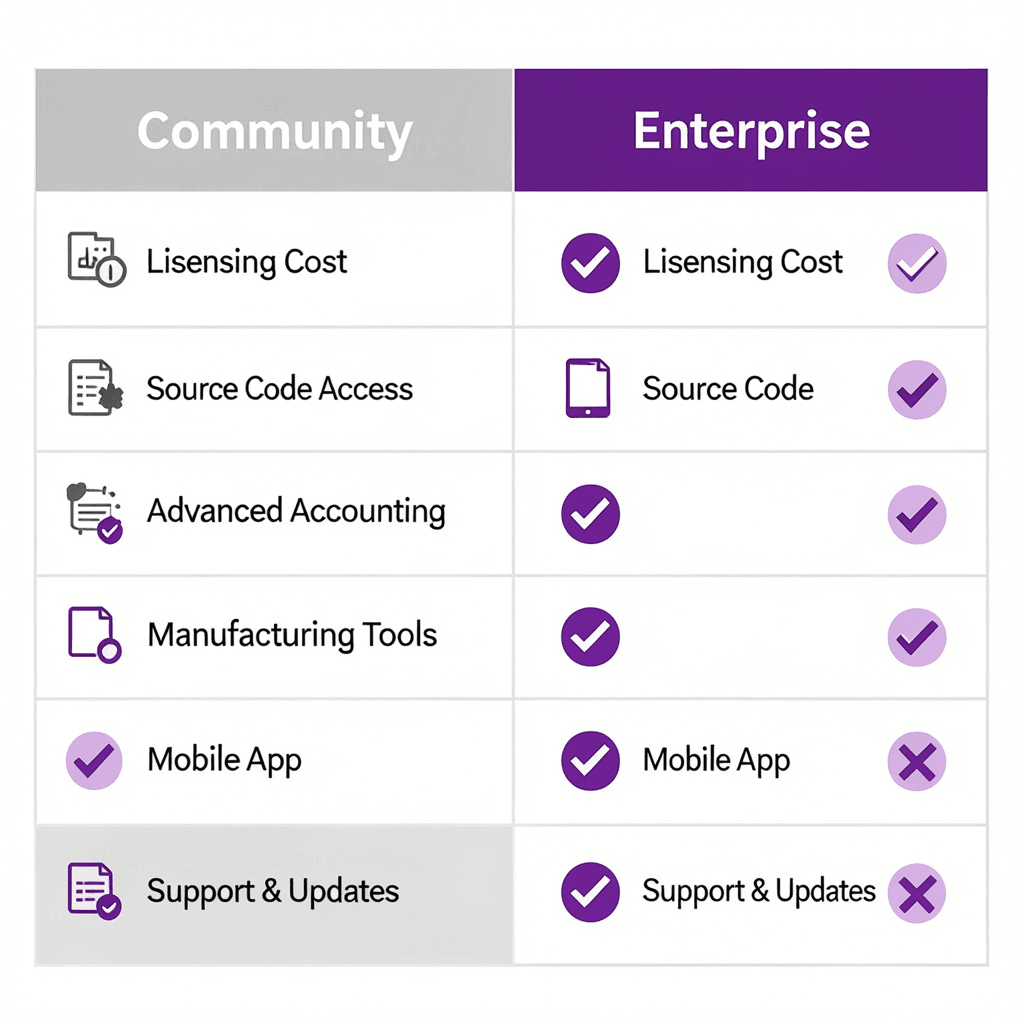
- Licensing cost – Community is free; Enterprise charges per user.
- Source code access – Community gives you the whole codebase to play with; Enterprise locks down a few proprietary modules.
- Advanced accounting – Enterprise ships with UAE VAT-ready tools built in; on Community you’re bolting on third-party add-ons.
- Manufacturing and quality control – Barcode scanning, MRP II and quality checks come standard on Enterprise. Community doesn’t have them natively.
- Mobile application – Enterprise’s app is genuinely usable day to day; Community’s is limited enough that most of our clients skip it.
- Support and updates – Enterprise means a real support ticket and guaranteed upgrades from Odoo. On Community, you’re either fixing it yourself or leaning on a partner like us.
- Helpdesk, appraisals and marketing automation – These simply aren’t available on Community at all.
If VAT compliance or any of those regulated modules matter to your business, Enterprise tends to pay for itself just by saving you the headache.
How Much Does Each Edition Actually Cost?
This is usually where the decision actually gets made, so let’s not dress it up.
Odoo Enterprise Pricing in the UAE
You’re looking at a per-user, per-app subscription, billed monthly or annually. What you’ll actually pay depends on how many users you have, which apps you switch on, and whether you go cloud or on-premise. Implementation, customisation and training sit on top of that, and the range there is wide enough that we’d rather quote it properly than guess.
Understanding Odoo Community vs Enterprise Cost
Here’s the trap most people fall into: assuming free means cheaper. It doesn’t always. Community has no licence fee, sure, but we’ve seen businesses spend more over two years patching together custom development and third-party apps to recreate features Enterprise already has out of the box. Enterprise costs more on day one and often less by year two.
Want a number that’s actually yours rather than a guess? Get in touch with our Odoo consultants and we’ll walk you through a proper cost breakdown based on your modules and user count.
Which Odoo Edition Should UAE Businesses Actually Choose?
There’s no universal right answer here, but this is roughly how the conversation with our clients usually goes:
- Go with Community if you’re running a lean erp for small business setup, you’ve got someone technical in-house, and you only really need sales, inventory or invoicing.
- Go with Enterprise if you’re in a regulated industry, need VAT-compliant accounting out of the box, want real support, or you’re planning to open across more than one emirate.
- Start with Community and grow into Enterprise if your budget is tight now but you expect that to change.
What Support and Customisation Options Come with Each Edition?
Nobody thinks about support until the day they need it. Community users are largely on their own: forums, documentation, or a certified partner if you have one. Enterprise users get a direct line to Odoo alongside whoever implemented the system, plus bug fixes and upgrades that actually arrive on schedule.
Customisation works differently too. Community hands you the full source code, which is great if you’ve got developers who want to get their hands dirty. Enterprise still allows plenty of customisation, just with a few proprietary modules kept off-limits. We build custom modules on both editions regularly, and honestly the “right” edition often comes down to what your developers are comfortable touching. Explore our Odoo customisation services if you want to see what’s realistic for your workflows.
There’s a catch people don’t think about until later: upgrades. Heavily customised Community installs can turn a version upgrade into a slow, expensive project, because someone has to manually reconcile every custom script against the new release. Enterprise’s upgrade path is more predictable, though even there, third-party modules need testing first. If you’re planning to open more branches across the UAE, this is often the thing that ends up mattering more than the sticker price.
How Do UAE Compliance Requirements Affect Your Decision?
UAE businesses have real obligations here, VAT filing and, more recently, e-invoicing requirements from the Federal Tax Authority. Enterprise generally arrives with more of that compliance work already built in, which takes pressure off your finance team. Community can get you there too, but usually needs extra configuration or third-party modules, and that adds both time and cost to the project.
Regulations here don’t stay still for long, so it’s worth talking to a partner who deals with Odoo in the UAE every day rather than occasionally. Book a free consultation with our team before you commit to an edition.
Frequently Asked Questions
1. What is the main difference in the Odoo community vs enterprise debate?
Money and depth, mostly. Community is free and open, built around core modules. Enterprise costs per user but adds the advanced features, official support and updates that Community simply doesn’t have.
2. Can I switch from Community to Enterprise later?
Yes, and plenty of businesses do exactly that. It’s not a flip of a switch though, expect data migration and some reconfiguration along the way. Starting small on Community and upgrading once you’ve outgrown it is a perfectly sensible path.
3. Is Odoo Enterprise worth the extra cost for a small business?
Depends what you actually need. If VAT compliance, real support or modules like manufacturing and helpdesk matter to you, Enterprise often ends up cheaper than the workarounds you’d need to build on Community.
4. Does the free, open source version of Odoo receive updates?
It does, but they come from the community rather than Odoo itself, so they’re less frequent and less predictable than what Enterprise subscribers get.
5. Which edition is better for UAE retail and e-commerce businesses?
Enterprise, in most cases. Point-of-sale integration, inventory automation and the built-in marketing tools save a lot of custom work that Community would otherwise need.
Making the Odoo Community vs Enterprise Decision for Your UAE Business
Neither edition is the “correct” one. It genuinely depends on your budget, your technical bench strength, your compliance obligations, and how fast you expect to grow. We’ve spent over a decade implementing both across the UAE as a trusted Odoo partner in UAE, , and if you’re still on the fence, that’s exactly the kind of conversation we’re good at having. Reach out to our Odoo experts and let’s figure out what actually fits.