


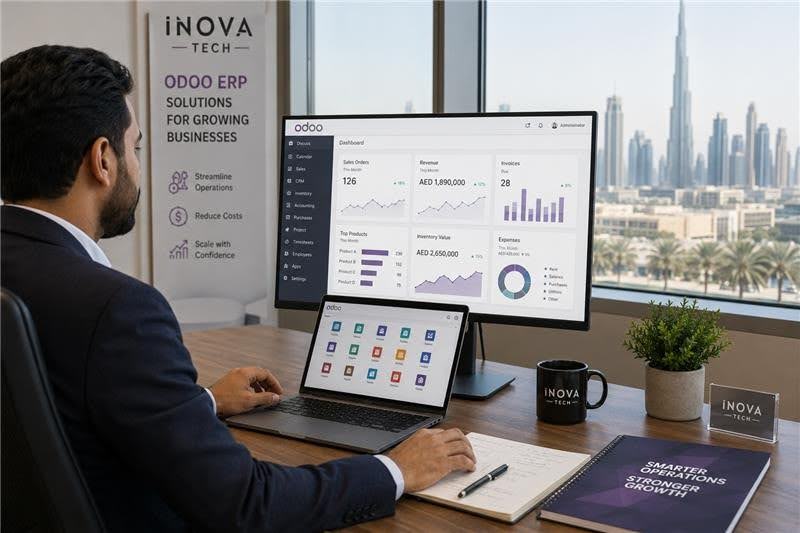
Most businesses don’t outgrow their software because the software was bad. They outgrow it because it was never built to grow with them. Requirements shift, headcount grows, and a system that felt adequate at launch starts creaking under workarounds and spreadsheets bolted on the side. This piece looks at why so many companies in the UAE end up replacing their systems every few years, and how Odoo ERP breaks that cycle by staying flexible enough to scale alongside the business rather than against it. According to Grand View Research, the UAE ERP software market is projected to grow at a compound annual rate of 11.6% between 2026 and 2033, which tells you plenty about how many companies are actively rethinking their systems right now.
At Inova Tech, we’ve spent over a decade implementing and customising Odoo for businesses across the UAE, so this article draws on patterns we see repeatedly with our own clients, from small trading firms to established manufacturers.
Objective
This article aims to explain why so many UAE businesses hit a wall with their existing software within a few years, and how a properly implemented ERP system addresses the three most common pain points: rising costs, disconnected operations, and limited scalability.
Key Takeaways
- Frequent software switching usually points to a system that wasn’t modular or scalable from the start.
- Odoo covers finance, inventory, sales, HR, and more within a single platform, cutting down on tool sprawl.
- Cloud deployment is now the dominant choice in the UAE, largely because it lowers upfront cost and simplifies updates.
- Modular systems let businesses add functionality gradually instead of over-buying on day one.
- Local implementation support matters just as much as the software itself.
- Real-time reporting across departments removes a lot of the guesswork from decision-making.
- Data migration, when planned properly, doesn’t have to be the headache most businesses expect.
Why Odoo ERP Works So Well for UAE Businesses
Odoo isn’t the only ERP option in the region, but it tends to solve the problem that pushes companies to switch systems in the first place: rigidity. Traditional platforms often lock businesses into a fixed set of modules, so as needs change, companies either pay for expensive custom development or migrate to something new entirely. Odoo takes a different approach by treating the platform as a set of building blocks rather than a fixed package, which is exactly why so many UAE businesses stick with it well beyond the three-year mark that trips up other systems.
Lower Total Cost of Ownership
- Open-source core licensing reduces upfront software costs
- Modular pricing means you only pay for what you’re using
- Cloud hosting removes the need for on-site servers and dedicated IT infrastructure
- Fewer third-party integrations means fewer subscription fees stacking up over time
Businesses that previously ran five or six separate tools for accounting, inventory, HR, and CRM often find that consolidating onto one platform pays for the implementation cost within the first year or two, purely through reduced software spend.
Operational Efficiency Gains
Bringing finance, inventory, sales, and HR onto one platform removes the manual re-entry and reconciliation that eats up hours every week. Teams work from the same data in real time, cutting down on errors caused by three different spreadsheets telling three different stories.
Example: Retail and Distribution
A retailer running separate systems for point of sale, inventory, and accounting typically spends hours each week matching numbers between them. One platform removes that reconciliation work almost entirely.
Better Decision-Making with Real-Time Reporting
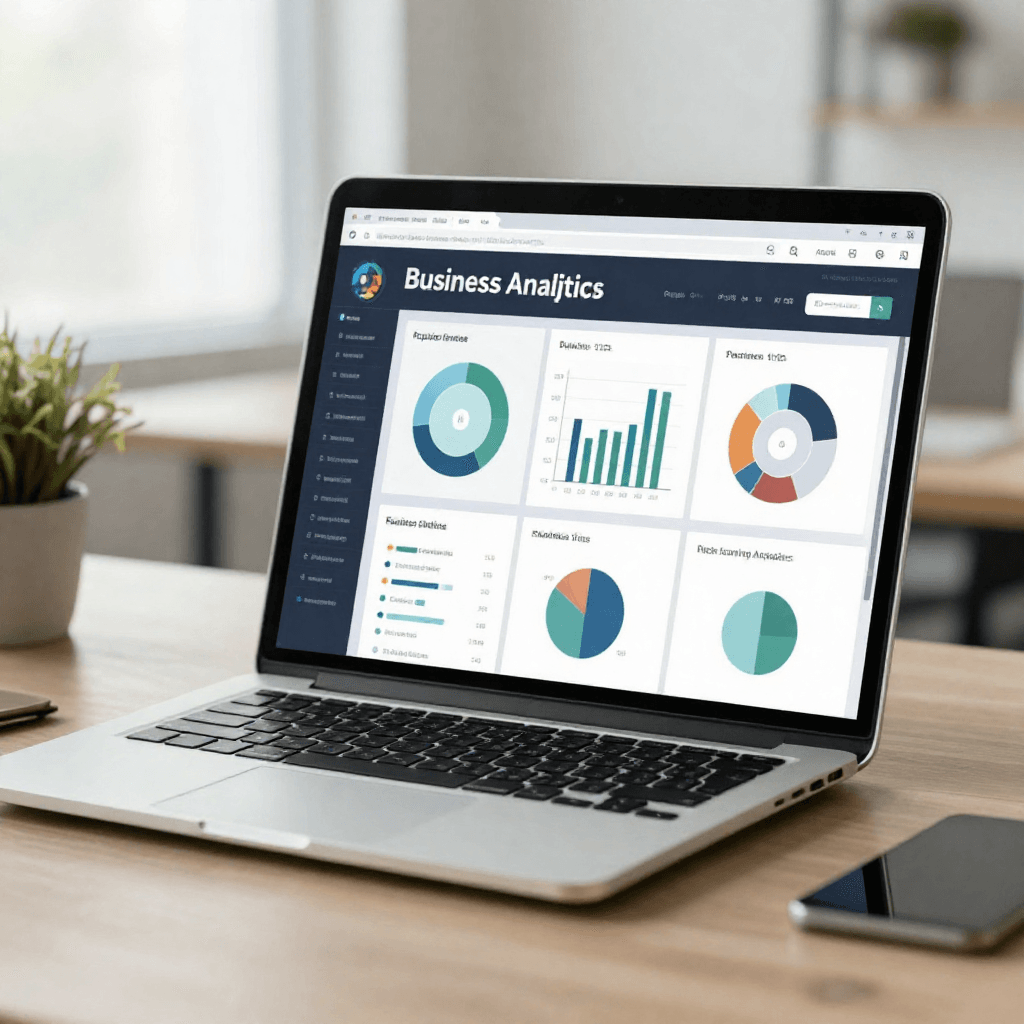
When every department feeds into the same system, reports stop being a monthly exercise in copying and pasting from five different exports. Dashboards update as transactions happen, so a stock shortage or a dip in margin shows up straight away rather than surfacing weeks later in a spreadsheet nobody checked.
Scalability Without Replatforming
Adding Modules as You Grow
Because Odoo is built in modules, a business can start with accounting and inventory, then add CRM, manufacturing, or HR later without a full system overhaul. That’s the core reason companies stop the “switch every three years” cycle once they move to a properly configured setup. We’ve seen businesses go from a two-module starting point to a fully integrated operation covering ten or more apps, without ever needing to migrate platforms.
Feeling boxed in by your current system? It’s worth a conversation with our team before committing to another costly migration.
What Makes Companies Switch ERP Systems Every Few Years?
A handful of recurring issues tend to be behind most switches:
- The original system wasn’t scalable, so growth forced a rebuild rather than an expansion
- Departments ended up using separate tools that never talked to each other properly
- Customisation costs kept climbing every time a new requirement came up
- Reporting stayed manual because the software couldn’t pull data across departments
- Vendor support was slow, generic, or simply unavailable locally
- The original implementation was rushed, so the setup never really matched how the business actually worked
Recognising these patterns early can save a business from repeating the same costly cycle again. The businesses that avoid this trap almost always invested time upfront in mapping their workflows before configuration began.
How Does an Odoo ERP System Support Long-Term Scalability?
Odoo is built around apps rather than one rigid structure, so scaling usually means switching on a new module rather than rebuilding from scratch. A construction firm might start with project costing and procurement, then add field service management as site operations expand. A retail brand might begin with point of sale and inventory, then layer in e-commerce and marketing automation as it grows online. A healthcare provider might start with appointment scheduling and billing, then add inventory management for medical supplies once the practice expands to multiple locations.
Working with an experienced implementation partner counts here. Configuration decisions made early affect how smoothly future modules integrate, so it pays to get the initial setup right. A poorly mapped chart of accounts or an inconsistent product catalogue at the start can create rework months or years down the line.
Finding the Right ERP Solution UAE Businesses Can Actually Rely On
Not every implementation delivers the same results, even on the same software. We’ve seen two businesses run identical modules and come away with completely different outcomes, purely down to how the initial setup was handled. Before signing with a partner, it’s worth asking a few pointed questions:
- Do they actually understand your industry’s workflows, or is it generic ERP theory dressed up as advice?
- Have they got real UAE-based implementations to show you, ideally in a sector close to yours?
- Does support and training carry on after go-live, or does the relationship end the moment the system’s switched on?
- Can the setup handle new modules being added later, or are you locked into what you buy on day one?
- Is support actually local, in your time zone, or will you be emailing an overseas team and waiting?
We cover construction, healthcare, logistics, retail, and hospitality, among others. If you’d like a second opinion on your current setup, just reach out and our team will talk you through it.
Frequently Asked Questions
1. What is Odoo ERP?
Think of it as one connected system standing in for a dozen separate ones: accounting, inventory, sales, CRM, HR, manufacturing. It’s modular, so businesses tend to build it up piece by piece rather than buying everything at once.
2. Is Odoo suitable for small businesses, or only large enterprises?
Both. We’ve set up small businesses with just two modules to start, accounting and inventory, and we’ve built out full multi-site operations for larger enterprises across several subsidiaries. It scales in either direction.
3. How long does a typical Odoo implementation take in the UAE?
Depends entirely on scope. A simple setup might be done in a few weeks. Something fully customised across multiple departments can run into months, and the timeline usually comes down to how much process mapping is needed rather than the software itself.
4. Does switching to Odoo mean losing existing business data?
No, not if it’s done properly. A solid migration plan carries your historical data across, and any implementation partner worth working with will test that thoroughly in a staging environment before anything goes live for real.
5. What ongoing support is available after implementation?
Varies by provider, but at Inova Tech we stick around after go-live. Training, customisation, continued support, whatever’s needed so you’re not left figuring out updates and new modules on your own.
Choosing Odoo for Long-Term Business Growth
The real cost of switching software every few years isn’t just the licence fees. It’s the lost productivity, the retraining, and the data migration headaches that come with every changeover. A modular, well-configured platform avoids most of that by growing alongside the business instead of forcing a rebuild each time requirements change. The businesses that get the most out of their odoo erp investment tend to be the ones that treat implementation as an ongoing partnership rather than a one-off project.
Weighing up your options? Get in touch with our team at Inova Tech and we’ll walk you through what a properly scoped implementation could look like for your business.